
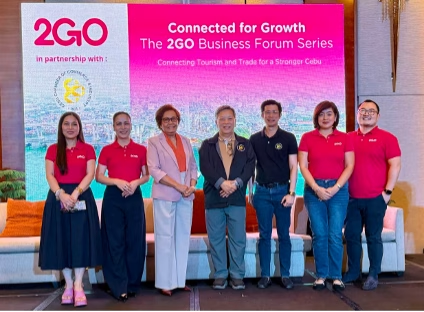
2GO, the country’s leading integrated transportation and logistics provider, gathered members of the Cebu business community, industry experts, and policymakers for a strategic forum dedicated to leveraging stronger connectivity that can sustain the region’s momentum across trade, tourism, and economic growth.
In partnership with the Cebu Chamber of Commerce and Industry (CCCI) and in coordination with the Department of Economy, Planning, and Development (DEPDev) Region VII, 2GO hosted a dialogue with key regional stakeholders to discuss Central Visayas’ economic outlook and the vital role of modern supply chain networks in linking businesses to markets and travelers to key destinations.
“We want to hear your pain points and identify your areas of growth so we can co-create solutions together,” said 2GO Marketing Business Unit Head Ethel Concepcion, underscoring the company’s dedication to sustained dialogue and collaborations that enable long-term progress for regional trade and tourism sectors.
“When connectivity improves, businesses can move products faster and more efficiently. Tourism destinations become more accessible, supply chains build resilience, and new markets open,” said CCCI President Regan Rex King. “A stronger Cebu requires stronger connections, and those links begin with meaningful cross-sector alignment.”
The partnership reflects the shared commitment of 2GO and CCCI to foster a holistic economic framework. Through its expansive multimodal network, 2GO bridges trade routes across the Philippines while collaborating with local organizations to unlock regional opportunities.
Highlighting the region’s trajectory, DEPDev Region VII Assistant Regional Director Evelyn Nacario-Castro presented an outlook emphasizing Central Visayas’ transition toward a more diversified and interconnected economy. Ranked as the country’s fourth-largest regional economy in 2025, Central Visayas is advancing toward modernized transit and freight infrastructure, backed by 90 strategic high-impact projects (SHIPs) scheduled in 2027.
The forum held an executive panel titled “Strengthening Connectivity for Tourism, Trade, and Regional Growth,” featuring insights from King alongside 2GO leaders Francis John Chua (Travel), Faye Allonzo (Forwarding), and Sharon Musngi-Ngo (Sea Solutions).
With logistics playing a pivotal role in accelerating regional development, 2GO reaffirmed its commitment to deepening ties with commercial enterprises, government bodies, and trade groups to build reliable connections across Central Visayas.